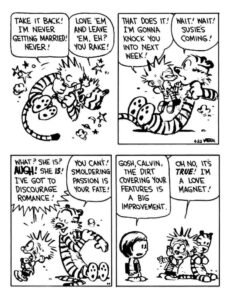
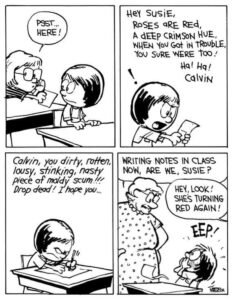
For anyone who grew up between the 1980s and the early 2000s, weekday mornings and after-school hours were often reserved for one thing: the funny pages. And nestled within those newspapers was a strip that was more than just a comic—it was a philosophy lesson wrapped in crayon colors. Calvin and Hobbes, created by the brilliant Bill Watterson, wasn’t just about a mischievous six-year-old and his stuffed tiger. It was a mirror reflecting our own childhood fears, our wild imaginations, and our quiet moments of wonder.
Even decades after the last strip was published, the words of Calvin, Hobbes, and even the long-suffering parents continue to resonate with us. They remind us of a time when the biggest worry was a homework assignment, and the greatest joy was a snowy hill and a trusty sled. These quotes aren’t just lines of dialogue; they are fragments of our collective memory. They speak to the adult we’ve become while whispering to the child we still are inside. Let’s take a nostalgic journey back to the playground of our minds and revisit ten timeless quotes that helped define our childhood.
10 + Calvin and Hobbes Comics
Image credit : Bill Watterson
#1
#2
#3
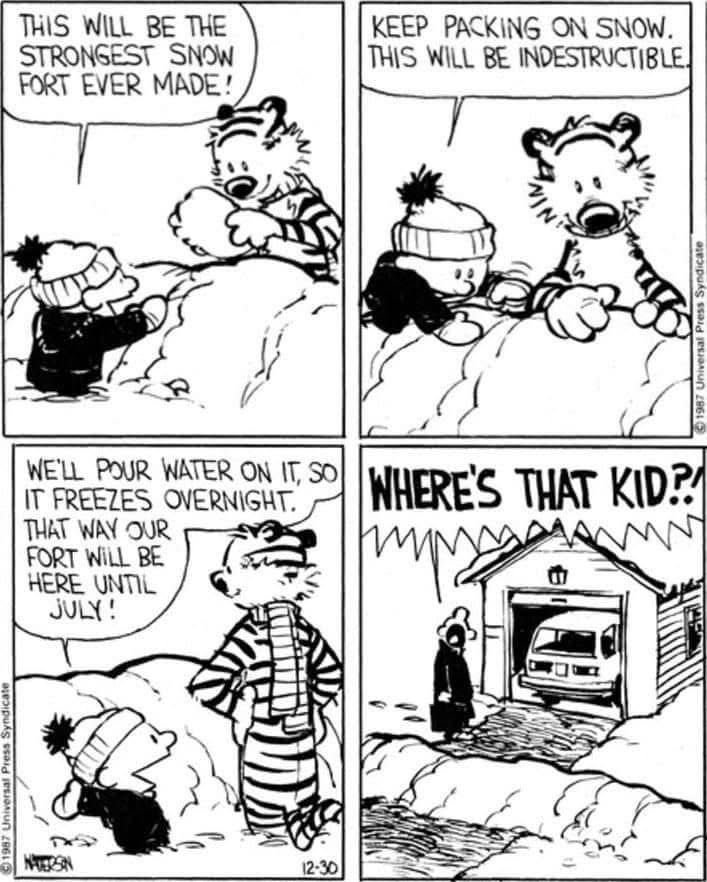
#4
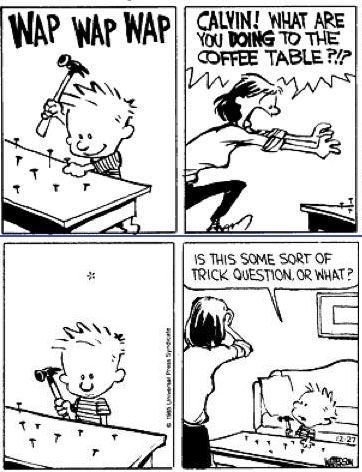
#5
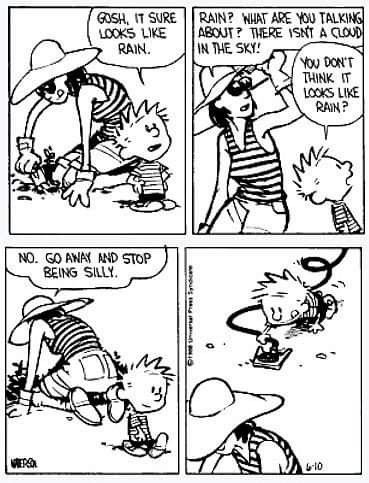
#6
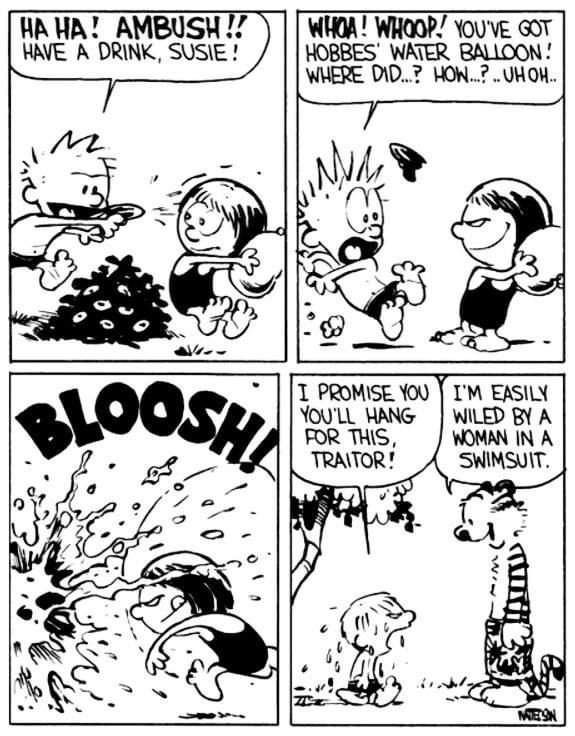
#7
#8
#9
#10
The Magic of a Snowy Day and a Trusty Sidekick
There is no duo in the history of comics quite like Calvin and Hobbes. Their friendship was the emotional core of the strip, and it taught us the true value of having a partner in crime. Whether they were zooming down a hill in a wagon or debating the nature of the universe, their bond was unbreakable. It reminded us that childhood is best experienced with someone by your side—even if that someone exists only in your imagination.
One of the most iconic images from the entire series is that of Calvin and his tiger soaring through the air on their sled. It represents pure, unadulterated joy. As Hobbes wisely put it, “It’s a magical world, Hobbes, ol’ buddy… Let’s go exploring!” This quote perfectly captures the boundless optimism of youth. The world was a giant, unexplored backyard, and every day held the potential for a new adventure. We felt that same thrill when we rode our bikes to a new part of the neighborhood or built a fort in the woods.
Of course, their friendship wasn’t just about the big adventures. It was also about the quiet moments of reflection. Calvin often struggled to make sense of the adult world, with its confusing rules and endless responsibilities. In those moments, Hobbes was the voice of calm, simple logic. When Calvin lamented about the complexity of life, Hobbes offered a grounding perspective. He famously said, “The problem with the future is that it keeps turning into the present.” As kids, we lived entirely in the now, and this quote perfectly articulated that feeling of wanting to hold onto the moment just a little bit longer before it slipped away.
This dynamic duo taught us that the best friendships are the ones where you can be completely yourself. Calvin was loud, impulsive, and messy. Hobbes was thoughtful, calm, and tidy. They balanced each other out. They showed us that true friends don’t try to change you; they just jump on the sled with you, no matter how steep the hill might be.
Questioning the Absurdity of Grown-Up Rules
If there is one thing Calvin was a master of, it was questioning authority—specifically, the authority of parents and teachers who seemed to have made it their life’s mission to ruin his fun. His battles with his mom, dad, and his teacher, Mrs. Wormwood, were legendary. They highlighted the constant friction between a child’s desire for freedom and an adult’s need for order. We all saw a bit of ourselves in Calvin’s rebellious streak.
Calvin’s disdain for schoolwork and chores was something every kid could relate to. He viewed the daily grind of life as a pointless distraction from the important things, like building a snowman or transmogrifying himself into a dinosaur. His frustration often boiled over into hilarious rants about the unfairness of it all. One of his most memorable complaints perfectly sums up this feeling: “Why waste time learning about volcanoes when you can just go outside and jump in a pile of leaves?” It’s a line that champions the thrill of experience over the boredom of instruction, a sentiment we all felt on a perfect autumn afternoon.
But the humor wasn’t just in Calvin’s rebellion; it was also in the subtle, weary wisdom of his parents. They were the unsung heroes of the strip, constantly trying to civilize a wild child with a healthy dose of sarcasm and patience. When Calvin asked his dad why old photos are always in black and white, his dad delivered one of the most classic deadpan responses in comic history: “Because the world was black and white back then.” As kids, we laughed because it was silly. As adults, we laugh because we realize that’s exactly the kind of ridiculous answer we would give our own children just to see their reaction.
These interactions between Calvin and the adults in his life taught us that the rules of the world are often arbitrary. They encouraged us to question things and to find humor in the mundane struggles of daily life. Whether it was protesting a bath or negotiating a later bedtime, Calvin was fighting the good fight for kids everywhere, reminding us that sometimes, the rules don’t make a lick of sense.
The Depth Hidden in Simple Wisdom
While Hobbes was often the straight man to Calvin’s wild antics, he was also the vessel for some of the strip’s most profound observations. He had a way of cutting through the noise and getting to the heart of the matter with a simplicity that only a tiger (or a child) could possess. These moments of quiet wisdom are what elevated Calvin and Hobbes from a simple comic strip to a work of art.
We often complicate things as we grow up. A minor mistake can feel like a catastrophe, and a missed opportunity can feel like the end of the world. Hobbes, however, had a different take. He understood the beauty of imperfection and the importance of perspective. In one strip, after Calvin completely bungles a project or a plan, Hobbes simply offers, “If people sat outside and looked at the stars each night, I’ll bet they’d live a lot differently.” It’s a gentle reminder to zoom out, to look at the bigger picture, and to realize that our daily problems are tiny specks in a vast, beautiful universe.
This kind of wisdom resonated with us as children because it felt true. We hadn’t yet built up the walls of cynicism that adults often carry. We could still look at the stars and feel a sense of awe. Hobbes helped us articulate that feeling. He validated the idea that the simple things—a warm fire, a good book, a friend beside you—are often the most important. He taught us that “It’s surprising how much of memory is built around things unnoticed at the time.” How many of us remember the smell of our grandparent’s house or the sound of rain on the roof without ever consciously noting it at the moment?
In the end, the tiger with the knowing smile reminded us that life isn’t about achieving great things or following the rules. It’s about the moments in between. It’s about the quiet conversations, the shared silences, and the simple act of being present. Hobbes’s philosophy was a gentle guide for a young reader trying to navigate a complicated world, and it’s a philosophy that continues to bring us comfort today.
Embracing the Power of Imagination
Perhaps the greatest gift Calvin and Hobbes gave us was the validation of our imagination. Calvin’s world was not limited by the four walls of his house or the boundaries of his backyard. Through the power of his mind, he could become Spaceman Spiff, piloting a starship through alien galaxies, or a fearless dinosaur, roaming a primordial world. His imagination was his escape hatch from the boring realities of life.
This made us feel seen. Every child has an inner world where they are the hero of their own story. We all had imaginary friends, secret identities, and epic adventures that played out in our heads. Bill Watterson captured that perfectly. Calvin’s imagination wasn’t just a coping mechanism; it was a superpower. It was a declaration that the world is only as dull as you allow it to be. He showed us that “It’s not denial. I’m just selective about the reality I accept.” This wasn’t about lying; it was about choosing wonder over drudgery.
The brilliance of the strip was that it never clearly stated whether Hobbes was real or imagined. In the panels where Calvin was alone, Hobbes was a stuffed animal. But in the panels of their adventures, Hobbes was a fully-realized, living, breathing companion. This ambiguity was the point. It told us that the line between imagination and reality is blurry, and that’s okay. The emotions, the friendship, and the adventures were real, even if they existed only in Calvin’s mind. It taught us to value our creativity.
As we grew up, the call to use our imagination became quieter. The demands of school, work, and life pushed it to the background. But re-reading these quotes reminds us that the ability to see the world with fresh eyes is a gift we shouldn’t abandon. Calvin’s imagination was his greatest tool for survival. It allowed him to turn a boring walk home into an intergalactic trek and transform a cardboard box into a time machine. He taught us that as long as you have your mind, you have the keys to the most incredible adventures. And that’s a lesson we can carry with us forever, long after we’ve put away the sled.