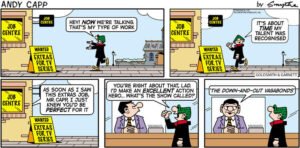
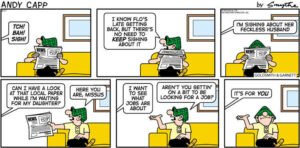
For decades, the sight of a man in a flat cap with his collar turned up, usually found leaning against a bar or snoozing on his sofa, has been a staple of newspaper funny pages around the world. Andy Capp, the creation of British cartoonist Reg Smythe, first appeared in 1957 and quickly became a global phenomenon . He is the ultimate layabout: a working-class fellow from the North East of England who would rather spend his day at the pub or betting on the dogs than doing an honest day’s work. His long-suffering wife, Flo, is usually the one heading off to earn the money while Andy figures out how to spend it.
But humor changes over time. What made people laugh in the 1960s and 70s can sometimes feel awkward, or even offensive, today. Andy Capp, with his love for beer, his tendency to get into fights, and his often-difficult relationship with his wife, represents a brand of comedy that feels like it belongs to a different era. This raises a fair question for modern readers: does this old-school comic strip still hold up, or is it simply a relic of a less sensitive time?
In a world that is increasingly aware of issues like gender equality, healthy relationships, and work-life balance, the antics of a “lovable rogue” can sometimes seem less lovable and more problematic. However, the strip still runs in over 1,400 newspapers worldwide, suggesting that it still has an audience . So, let’s pull up a stool, order a pint, and take a closer look at whether Andy Capp is still funny in the modern world, or if it’s time for him to finally pick up the tab and call it a night.
10+ Andy Capp
Image Credit: Reg Smythe
#1

#2

#3

#4

#5

#6

#7

#8

#9

#10

The Classic Appeal: Why We Loved the Lovable Rogue
To understand Andy Capp’s place today, it helps to remember why he became so popular in the first place. At his core, Andy is the ultimate everyman for anyone who has ever felt like rebelling against the daily grind. He doesn’t want to wear a suit, he doesn’t want to answer to a boss, and he wants nothing more than to enjoy a simple pint with his mates. For many readers, especially those stuck in monotonous jobs, Andy’s life—as messy as it is—represents a sort of funny freedom. He answers to no one (except maybe Flo, when she’s had enough).
The humor of the strip originally came from its sharp depiction of British working-class life. Reg Smythe, a native of the region, wasn’t making fun of Northerners from the outside; he was holding a mirror up to a culture he knew well . The name itself, “Andy Capp,” is a playful phonetic spelling of “handicap,” suggesting that Andy is the burden his wife has to carry through life . This clever wordplay set the tone for a strip that was always smarter than its main character. The jokes weren’t just “Andy is lazy”; they were about the dynamics of a marriage, the camaraderie of the local pub, and the small victories and defeats of everyday life.
For a long time, Andy was seen as a “lovable rogue” —a scoundrel, sure, but one with a certain charm. The strip thrived on the tension between his selfishness and the moments where you could see a tiny, often hidden, glimmer of affection for Flo. Readers enjoyed the predictable pattern: Andy would try something lazy, Flo would catch him, and chaos (often in the form of a rolling cloud of dust from a fight) would ensue . It was a safe, familiar kind of humor that millions grew up with, making the character feel like a naughty but beloved member of the family.
The Elephant in the Room: Domestic Abuse and Modern Sensibilities
This is the biggest hurdle for the strip in the 21st century. If you go back and read some of the earlier Andy Capp comics, you will quickly notice that the humor was often based on physical conflict between Andy and Flo. It wasn’t just verbal sparring; it was common to see a cloud of dust with a fist or a foot sticking out, implying that a physical fight had just broken out between husband and wife . For decades, this was played for laughs—the idea of the henpecked husband fighting back, or the wife giving as good as she got.
Today, however, domestic abuse is not a joking matter. Our understanding of relationships has evolved significantly. We now recognize that portraying physical violence between partners as a comedic punchline is harmful and trivializes a very serious issue. The TV Tropes entry on the strip notes that this aspect has been “toned down considerably from the strip’s early years,” acknowledging that the creative team behind the strip has likely recognized the need to change . Even a pop culture touchstone like The Simpsons lampooned this aspect years ago, with Homer Simpson famously muttering, “Heh, heh, heh… Oh, Andy Capp. You wife-beating drunk” .
The shift away from this type of humor is a positive sign that the strip can adapt. Modern readers, particularly younger ones, are unlikely to find a man physically fighting with his wife funny. They are more likely to find it disturbing. For Andy Capp to survive, it has had to almost entirely abandon this part of its comedic DNA. While older fans might remember these gags fondly as “of their time,” their absence in newer strips is necessary for the comic to have any place in today’s newspapers. The question is, without that edge, does the strip still have enough bite?
Is the “Lazy Husband” Trope Outdated?
Beyond the physical violence, the entire premise of Andy Capp is built on a stereotype that is increasingly out of step with modern relationships: the “lazy, good-for-nothing husband.” In the world of Andy Capp, gender roles are rigidly defined and frozen in time. Flo goes to work (often as a cleaner or in a shop), cooks the meals, and cleans the house, while Andy sits on the couch, reads the paper, and then heads to the pub. He is a financial and emotional drain, yet the strip often frames his behavior as a quirky personality trait rather than a serious character flaw.
In 2024, the dynamics of a household look very different than they did in 1957. Dual-income families are the norm, and the expectation of shared domestic labor is much higher. The idea of a husband who contributes absolutely nothing, belittles his wife’s efforts, and spends the housekeeping money on beer feels less like a “rogue” and more like a cautionary tale. Younger generations, who value partnership and equality in their relationships, might look at Andy not with amusement, but with disbelief that anyone would put up with him, or that we are supposed to find his behavior amusing.
However, one could argue that the joke is, and always has been, on Andy. He is not a hero; he is a cautionary example of what not to become. The humor comes from his comeuppance—the moment Flo outsmarts him, or he falls flat on his face. In that sense, the strip still works because it ultimately punishes bad behavior. But this requires a level of media literacy that casual readers might not have. If a reader just sees Andy getting away with his antics day after day without any real consequence, the strip can feel like it is endorsing the very lifestyle it should be mocking.
Keeping Up with the Times: How the Strip Has (and Hasn’t) Changed
Since Reg Smythe passed away in 1998, the strip has been taken over by other artists and writers, most notably Roger Mahoney and Roger Kettle . This is always a tricky transition for any long-running comic. The challenge is to keep the spirit of the original characters alive while gently nudging them into the present day. So, how has the “new” Andy Capp fared? Based on commentary from dedicated readers and critics, the answer is… it’s a mixed bag.
Some critics point out that the strip now exists in a kind of weird, timeless bubble. For example, a recent strip referenced subcultures from a movie that is nearly 50 years old, leading one blogger to joke that Andy might be an “eldritch, immortal being” . This suggests that the writing hasn’t quite figured out how to make Andy relevant to the 2020s without turning him into a time traveler. The references feel dated, and the jokes sometimes rely on knowledge of the strip’s 60-year history, which can be confusing for new readers .
On the other hand, the art style has subtly modernized, and the more offensive elements (like the implied violence) have been cleaned up. The strip also spawned a sort-of spin-off called Mandy Capp, featuring Andy and Flo’s granddaughter, a single mother, which attempts to bring the family dynamic into a more contemporary setting . This shows that the franchise is trying to evolve. However, for the main strip, the challenge remains: how do you make a character whose entire personality is based on being a lazy, beer-drinking anachronism feel fresh and funny in an era of craft breweries, remote work, and shared parental leave?
So, Is He Still Funny?
So, we come back to the original question: Is Andy Capp still funny? The answer is not a simple yes or no. It depends heavily on the reader and the specific strip in question. If you are looking at the classic reprints from the 60s and 70s, you are likely to find a mix of genuinely witty social commentary and humor that has not aged well, particularly regarding gender and violence.
If you are reading the modern strips, the experience is different. The humor has become softer and safer. The jokes now tend to focus on Andy’s laziness, his love of beer, and his simple-minded get-rich-quick schemes. It has shifted from being a slightly edgy slice-of-life comic to a more generic gag panel about a funny-looking man and his patient wife. Sites like The Comics Curmudgeon often poke fun at the strip not for being offensive, but for being boring or confusing . The danger for Andy Capp today isn’t that he will outrage readers; it’s that he will bore them.
Ultimately, Andy Capp’s place in the modern world is that of a nostalgic artifact. For older generations, he is a familiar face, a reminder of a simpler time in comics. For younger readers discovering him for the first time, he might seem like a confusing relic from a bygone era of gender politics. He can still be funny, particularly in the strips where his schemes blow up in his face or Flo gets the last word. But the laughter is often tempered with a recognition that the world Andy Capp lives in is not the world we live in now. He may have secured his place in a few more years of newspaper print, but his ability to make us laugh requires us to leave our 21st-century sensibilities at the door—and that is a harder ask than it used to be.