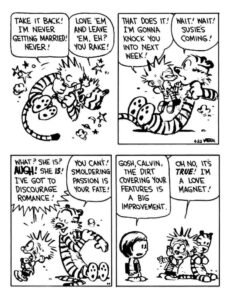
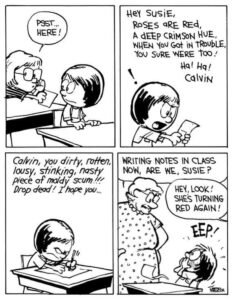
If you grew up in the late 80s or 90s, there is a good chance that your childhood was defined by the mischievous grin of a six-year-old and the deadpan stare of his stuffed tiger. “Calvin and Hobbes” wasn’t just a comic strip; it was a philosophy course disguised with crayons and water balloons. Created by the brilliant Bill Watterson, this strip followed the adventures of Calvin, a precocious and impulsive boy, and Hobbes, his loyal tiger who, from Calvin’s perspective, was as real and alive as anyone else.
Rereading these comics as an adult hits differently. You start to realize that the story wasn’t just about a boy and his pet. It was a deep exploration of life, friendship, imagination, and the often-absurd world of adults. Looking back, I can see that Hobbes wasn’t just teaching Calvin how to pounce; he was teaching all of us how to live. Here are five life-changing lessons I learned from the best philosophical duo in the history of newspapers.
10+ Calvin and Hobbes
Image Credit: Pintrest.com
#1

#2

#3

#4

#5

#6

#7

#8

#9

#10

1. The Power of an Unlimited Imagination
In a world where we are glued to screens and notifications, Calvin stands as a beacon of what pure, unadulterated imagination looks like. A simple cardboard box was never just a box to Calvin. It was a transmogrifier, a time machine, or a duplicator. A trip to the backyard was an expedition to another planet or a journey back to the Jurassic era. He didn’t need expensive gadgets or the latest video games to have the time of his life; he just needed his thoughts and his best friend.
This teaches us a vital lesson about happiness and contentment. As we grow up, we often lose the ability to see magic in the mundane. We trade imagination for practicality and wonder for routine. Calvin reminds us that the world is only as boring as we allow it to be. You don’t need to escape reality; you just need to find a way to decorate it with your dreams.
Bringing a little bit of this mindset into adulthood can transform our stress levels. When we are stuck in traffic, we can listen to a podcast and learn something new. When we are doing chores, we can turn it into a game to see how fast we can finish. Imagination isn’t just for kids; it is the secret ingredient that keeps life from feeling like a repetitive chore. It allows us to find joy in the journey, not just the destination.
2. True Friendship Means Accepting Quirks and All
The relationship between Calvin and Hobbes is the heart of the entire series. Hobbes is not just a sidekick; he is the conscience, the voice of reason, and the best friend Calvin could ever ask for. What makes their bond so special is the unconditional acceptance. Hobbes sees Calvin at his worst—when he is selfish, when he cheats at cards, when he is being a brat—and he loves him anyway. He never tries to change who Calvin is.
Of course, that doesn’t mean Hobbes lets him get away with bad behavior. He often uses gentle wisdom or a well-timed pounce to bring Calvin back down to earth. But through it all, the loyalty is unwavering. Hobbes is the friend everyone wishes they had: the one who will join you in your fantasies but also make sure you don’t fall off the wagon while chasing them.
This teaches us that real friendship isn’t about finding someone perfect. It’s about finding someone whose imperfections you can tolerate, and who can tolerate yours. In our modern culture, we often discard friendships over minor disagreements or differences. Calvin and Hobbes show us that the deepest connections are forged in the fires of shared experience, patience, and the ability to laugh at ourselves. A true friend is your anchor in the storm and the one who helps you see the rainbow afterward.
3. The Importance of Questioning Authority
Calvin has a famously rocky relationship with the world of adults, particularly his parents, his teacher Miss Wormwood, and the neighborhood babysitter, Rosalyn. He constantly questions the rules imposed upon him. Why does he have to go to school? Why does he have to eat his vegetables? Why does he have to go to bed when he isn’t tired? While his motives are usually selfish (avoiding homework), the underlying theme is a healthy skepticism of the status quo.
We live in a world that often demands compliance. We are told to fit in, follow the path, and not rock the boat. Calvin, however, refuses to accept things just because “that’s the way they are.” He challenges the logic of the adult world, exposing how arbitrary and ridiculous some of our social constructs can be. He makes us question whether the rat race we are running is actually worth it.
This doesn’t mean we should all become rebellious troublemakers. But it does mean we should hold onto a piece of Calvin’s critical thinking. We should ask ourselves if we are doing things because we genuinely want to, or because society expects it. Questioning the path allows us to make sure we are heading in a direction that is right for us, rather than just following the crowd off a cliff. It’s about living a life that is authentic, not automatic.
4. Nature is the Best Escape from a Demanding World
One of the most recurring and beautiful themes in “Calvin and Hobbes” is the escape into nature. Whether Calvin and Hobbes are trudging through the woods, sledding down a snowy hill, or simply staring at the clouds, nature is presented as a sanctuary. It is the place where time slows down, where the pressures of school and parents fade away, and where the two friends can just “be.”
In today’s hyper-connected world, we are suffering from a nature deficit. We spend most of our time indoors, under artificial light, staring at glowing rectangles. Watterson’s artwork captures the awe-inspiring beauty of the natural world, from the quiet stillness of a snowfall to the vibrant chaos of a summer meadow. It reminds us that there is a whole world outside our front door that asks for nothing and gives everything.
Taking a page from Calvin’s book, we can learn that spending time outdoors is not just a hobby; it is a form of mental hygiene. A short walk in the park, sitting under a tree with a book, or just feeling the sun on your face can reset your mood and lower your anxiety. Nature has a way of putting our problems into perspective. When you are looking at a massive, starry sky, the email that annoyed you this morning suddenly doesn’t seem so important.
5. Find Joy in the Simple Moments
Perhaps the most profound lesson from the entire series is the focus on simple joy. The strips don’t end with Calvin winning a trophy or achieving some great goal. They end with him and Hobbes flying down a hill on a wagon, laughing hysterically. They end with them walking home from school, discussing the meaning of life while holding a popsicle. They end with them sitting in a tree, just watching the world go by.
Our society is obsessed with the “next big thing.” We think that once we get that promotion, that car, or that house, we will finally be happy. But Calvin and Hobbes reveal that this is a trap. Happiness isn’t a destination; it is a way of traveling. It is found in the small, fleeting moments that we often overlook while we are busy chasing the horizon. It’s the taste of a warm cookie, the feeling of grass under your feet, or the sound of a friend’s laughter.
Learning to appreciate these small moments is the secret to a rich life. You don’t need a million dollars to be happy; you just need a million small moments of joy. Calvin and Hobbes taught a generation that life is not about the big events, but about the quiet spaces in between. It’s about being present, being grateful, and making sure you take the time to stop and watch the clouds every once in a while. Because, as Calvin might say, it’s a magical world.