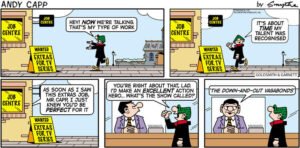
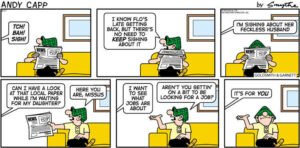
For decades, readers around the world have opened their newspapers and smiled at the sight of a scruffy man in a flat cap, sprawled on a couch or propped up at a bar. That man, of course, is Andy Capp, the beloved British comic strip character who has been entertaining audiences since 1957. But if you’ve ever stopped to think about it, his name might strike you as a little odd. It’s simple, catchy, and perfectly memorable. However, the story of why he is called “Andy Capp” is a fascinating journey into British culture, accents, and clever wordplay. It’s a name that tells you everything you need to know about the character before you even read a single strip .
The genius behind the name belongs to Reg Smythe, a cartoonist from Hartlepool in the North of England. Smythe grew up in the working-class environment he would later immortalize in ink. He understood the people, the language, and the humor of his hometown. When he sat down to name his new creation, he didn’t just pick a random name out of a hat. Instead, he crafted a pun that was both a description of the character and a nod to the local way of speaking. The name is a masterpiece of economy, telling us that Andy is a “handicap” to those around him and that his identity is literally hidden under his signature cap .
10+ Andy Capp
Image Credit: Reg Smythe
#1
#2
#3
#4
#5
#6
#7
#8
#9
#10
The Accidental Genius of “Handicap”
The primary explanation for Andy Capp’s name is a brilliant piece of phonetic wordplay. If you say “Andy Capp” out loud with a thick Northern English accent, it sounds almost identical to the word “handicap” . This was a deliberate and clever choice by creator Reg Smythe. In the context of the strip, the name is a perfect reflection of Andy’s personality and his role in the lives of those around him. He is, in many ways, a “handicap” to his long-suffering wife, Flo, and to society at large .
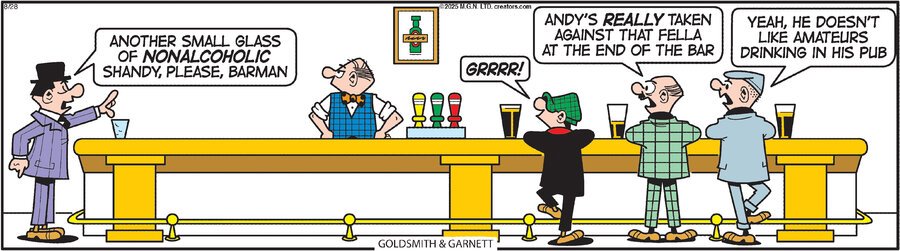
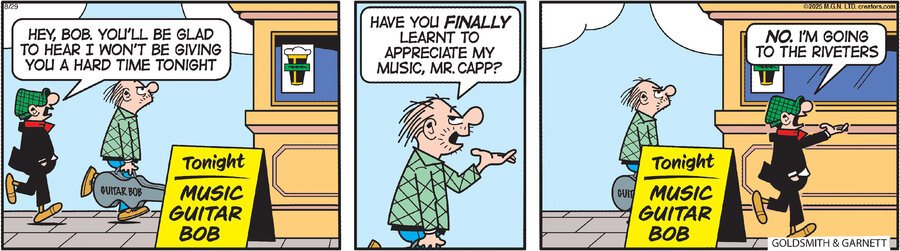
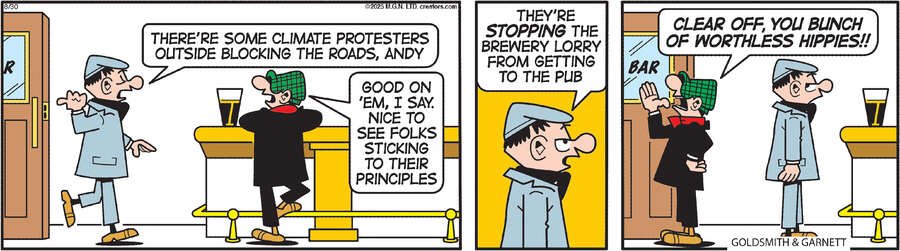
Think about it: Andy is perpetually unemployed, yet he always has money for a pint at the pub. He spends his days gambling on horses, pigeons, or games of pool, often losing money the family doesn’t have. He’s a burden on his wife, who works as a charwoman (a cleaning lady) to keep their tiny house from falling into complete ruin. He’s a handicap to the rent collector, Percy, who can never seem to get a penny out of him. He’s even a handicap to his local football (soccer) team, as he’s more likely to start a fight on the pitch than to score a goal. The name, born from a simple accent, perfectly encapsulates his entire character in a single word .
This type of wordplay is known as a homophonic pun, where two different words or phrases sound the same. It was an instant connection for British readers, particularly those from the North, who immediately understood the joke. It added a layer of depth to the strip from the very first panel. The name wasn’t just a label; it was the first joke, setting the tone for the witty and often cynical humor that would define the series for the next sixty years .
More Than a Name: The Symbolism of the “Cap”
Of course, the name Andy Capp isn’t just a sound-alike for “handicap.” The second part of the name, “Capp,” also serves a very literal purpose. It refers to the character’s most iconic physical feature: his flat cap. Andy is never seen without his checked cap, which is perpetually pulled down over his eyes. This is such a crucial part of his identity that Smythe made it his actual surname. The cap is more than just an article of clothing; it is a symbol of his entire worldview .
The cap physically obscures his vision, and metaphorically, it represents his limited outlook on life. Andy doesn’t see the consequences of his actions, the needs of his wife, or the benefit of getting a job. His world is small, consisting only of his couch, the pub, and the betting shop. The cap pulled over his eyes is a constant visual reminder that he is willfully blind to responsibility and the reality of his poverty. He can’t see (or refuses to see) the trouble he causes. When combined with the “handicap” pun, the name becomes a multi-layered masterpiece. He is a man handicapped by his own choices, and his “cap” is both the cause and the symbol of that handicap .
Even his wife’s name, Flo, follows a similar pattern of clever wordplay. Her full name is Florrie, but everyone calls her Flo. This is a play on the word “flue,” as in a chimney flue. In the strip’s early days, Flo was often seen with her head up the chimney, cleaning out the soot as part of her job as a charwoman. Just as Andy’s name describes his character and appearance, Flo’s name hints at her never-ending, dirty, and thankless work to keep their home together . It’s this consistent, clever use of language that makes the comic strip so endearing.
A Character Born from Real Life
The clever wordplay behind the name “Andy Capp” is even more impressive when you consider its origins. Reg Smythe wasn’t just a cartoonist making up silly names; he was drawing from his own life. Smythe grew up poor in Hartlepool during the Great Depression. He knew what it was like to be a “canvas shoes kid,” as he once described himself, meaning he was just one step above being barefoot . He understood the struggles of the working class because he lived them. After serving in the army, he held various jobs before finding success as a cartoonist .
Smythe once said that Andy was his “best friend,” even though he was a “lout.” He based Andy on the men he grew up with—men who were often unemployed due to the fluctuating economy of the shipbuilding towns, but who maintained a fierce pride and a dark sense of humor. The name “Andy Capp” was a way to pay homage to these men while also gently poking fun at their flaws. It was an affectionate nickname, not a cruel insult. The fact that the name was a local pun made it authentic. It was a joke that the people of Hartlepool would have immediately understood and appreciated, and it gave the character a sense of genuine place .
This authenticity is why the strip became a massive hit not just in Northern England, but across the entire country and eventually the world. People could sense that Andy was real. He wasn’t a caricature invented by someone looking down on the working class. He was a portrait painted by someone who was part of it. The name, with its clever wordplay, was the perfect introduction to this authentic, complicated, and strangely lovable character. It told readers that they were in for a story that was witty, realistic, and deeply human.
The Lasting Legacy of a Perfect Name
Since his first appearance on August 5, 1957, Andy Capp has become a cultural icon . The name, with its clever double meaning, has helped the character transcend the funny pages and become a part of popular culture. He has been referenced in hit shows like The Simpsons and Family Guy, where characters instantly understand the “wife-beating drunk” persona that the name implies . In one famous Simpsons episode, Homer reads the strip and sums up Andy’s entire character in a single, hilarious sentence, proving just how much information is packed into that simple name.
The legacy of the name also lives on in the world of consumer products. The “Andy Capp’s Fries” snack line uses the character’s likeness and name to sell its products . The connection is a natural one, as Andy is always depicted as a man who enjoys a snack and a pint. The name is so recognizable that it instantly conjures up an image and a feeling, making it a marketer’s dream. Even for people who have never read the comic strip, the name “Andy Capp” is synonymous with a certain type of lovable rogue.
In 2007, a statue of Andy Capp was finally erected in his creator’s hometown of Hartlepool, despite some initial controversy over whether the character promoted a negative stereotype . The statue stands as a testament to the enduring power of Reg Smythe’s creation. It’s a tribute to a character whose very name is a work of art. “Andy Capp” is more than just a name; it’s a story, a joke, a cultural touchstone, and a perfect example of how a little bit of clever wordplay can create a character that lives on for generations. It proves that sometimes, the best names are the ones that make you stop, think, and smile.