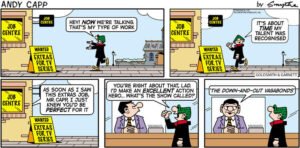
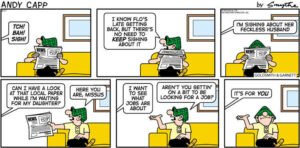
For over sixty years, readers around the world have opened their newspapers and smiled at the misadventures of a lazy, beer-loving man with a flat cap pulled over his eyes. Andy Capp first appeared in the British Daily Mirror on August 5, 1957. He was the creation of a cartoonist named Reg Smythe, who wanted to bring a Northern English character to the paper’s Manchester edition. The name itself is a clever pun. If you say “Andy Capp” with a Northern accent, it sounds just like the word “handicap.” And in many ways, Andy is exactly that—a handicap to his long-suffering wife, Flo, and sometimes to everyone around him.
However, the story of this comic strip is not just about a man who loves the pub and hates work. At its heart, “Andy Capp” is the story of a marriage. It is a loud, chaotic, and often argumentative partnership between Andy and his wife, Florrie, known to everyone as “Flo.” While Andy lounges on the sofa or falls into the canal after one too many pints, it is Flo who goes out to work as a cleaner to keep their tiny house at 37 Durham Street from falling apart. Their relationship is the engine of the strip’s humor. It is a constant battle of wills, a comedic war fought with rolling pins, sharp tongues, and, surprisingly, a deep, unspoken loyalty that has kept readers hooked for generations.
Image Credits : Gold Smith and Garnets
Andy Capp and Flo: The Real Story With 10+ Comics
#1

#2

#3

#4

#5

#6

#7

#8

#9

#10

Understand Andy and Flo
To understand Andy and Flo, you have to understand the man who drew them. Reg Smythe grew up in Hartlepool, in the northeast of England, in a family that knew poverty well. His father was a shipyard worker who often found himself unemployed, and Smythe once described himself as a “canvas shoes kid”—the poorest kid in school. When the Daily Mirror asked him to come up with a Northern character, he didn’t have to look far. The seven-hour drive from Hartlepool back to London became the birthplace of Andy Capp. He kept pulling over to the side of the A1 road, scribbling ideas on bits of paper until the character was born.
While Andy was inspired by the men Smythe saw at local football matches, the character of Flo was much closer to home. Smythe named Flo after his own mother, Florence. His mother wore a pinafore and headscarf, much like the character in the strip. This personal connection is why Flo is often considered the true heart of the comic. Smythe himself admitted that while the title focused on Andy, Flo was his favorite character, saying, “She should have been included in the title, but I wanted a single name.”
It is important to note that Smythe was nothing like his creation. His niece remembers him as a “very smart, sophisticated and good-looking man” who would never wear a flat cap, though she admits he did enjoy a gamble and a drink. This distance between the artist and his art allowed Smythe to portray Andy with a critical yet affectionate eye, creating a character you love to hate and hate to love.
Flo Capp: The Real Boss of 37 Durham Street
While Andy gets top billing, anyone who reads the strip knows that Flo is the real star. She is the one with the job, working as a “charwoman” or cleaner to bring in money. She is the one who deals with Percy the rent collector, who is always chasing them for the money they owe. And she is the one who puts up with Andy’s ridiculous schemes to avoid work and scrounge beer money. Without Flo, Andy would likely starve on the curb outside “The Pig and Whistle.”
Flo is not just a victim, though. In the early days of the strip, the humor was rougher around the edges. Flo would often be seen with a black eye after a fight with Andy. But it was always a two-way street. Flo gave as good as she got. She was just as likely to clobber Andy with a frying pan or a rolling pin as he was to take a swing at her. Their fights were drawn in a stylized way, often as a cloud of dust with fists and feet sticking out, which kept the violence in the realm of slapstick rather than something too real.
Beyond the fighting, Flo has her own life and her own vices. She loves playing Bingo just as much as Andy loves going to the pub, and she often stays out late with her best friend and neighbor, Rube White. This balance is what makes the marriage feel real. They are two stubborn people stuck together, annoying each other, but ultimately depending on each other. When Andy is in trouble, Flo is there. And despite his laziness, Andy has a soft spot for his “pet” and will instantly fight anyone who is rude to her.
Tackling the Tough Stuff: Smoking, Fighting, and Marriage Counseling
Comic strips are often a mirror of the times they live in, and Andy Capp is no different. Over its long run, the strip has changed with the decades, sometimes dropping old habits and adopting new ones. The most noticeable change happened in the 1980s. For years, Andy was rarely seen without a cigarette dangling from his lips. But in 1983, he quit. Many readers thought the newspaper forced Smythe to do it because of political correctness. However, the truth was much simpler: Reg Smythe himself had given up smoking and didn’t feel right drawing Andy puffing away when he couldn’t enjoy one himself.
Another major shift came in how the strip handled Andy and Flo’s fighting. As society became more aware of the issue of domestic violence, the stylized battles between the couple started to feel outdated. The cartoonists didn’t want to make light of a serious problem, so they evolved the characters. Instead of throwing punches, Andy and Flo started attending marriage counseling. This was a brilliant move by the writers. It kept the core conflict of the marriage alive but moved it from the physical to the psychological. Now, instead of a fistfight, we get to see them arguing in a therapist’s office, which is just as funny and much more fitting for a modern audience.
This ability to adapt has kept the strip alive. It proves that the humor was never really about the violence or the smoking; it was about the characters. Andy is still the same lazy layabout, and Flo is still the same fed-up wife, but now they deal with their issues in a way that reflects the 21st century. The fact that the strip can change with the times while keeping its soul is a testament to the strong foundation Reg Smythe built.
A Global Icon from a Small Town
You might think a strip about a unemployed man from Hartlepool would only appeal to a small audience. But you would be wrong. At its peak, Andy Capp was syndicated to over 1,700 newspapers worldwide and translated into 14 languages. It was as famous as Charles Schulz’s Peanuts in some parts of the world. The character became Tuffa Viktor in Sweden and Willi Wacker in Germany, where he became the mascot for FC Nuremberg football fans. One Turkish newspaper editor wrote that Andy was “as much Turkish as he is English… probably Greek, Italian and Polish too,” highlighting how universal the themes of laziness, marriage, and the battle of the sexes really are.
The strip has inspired more than just newspapers. There was a West End musical, a TV series starring James Bolam, and even a 1980s computer game where players had to help Andy get beer money while avoiding Flo. Back in his hometown of Hartlepool, a statue was erected in 2007 to honor the character and his creator. Even today, long after Reg Smythe’s death in 1998, the strip continues, drawn and written by a team who carefully maintain the look and feel of the originals.
When you look at Andy and Flo today, you are seeing the result of decades of history. They have survived the death of their creator, changes in social attitudes, and the decline of print newspapers. They remain relevant because their dynamic is timeless. We read about Andy and Flo and see the everyday battles of married life blown up to cartoonish proportions. We laugh at Andy’s schemes and wince at Flo’s burnt meals, but we also recognize the strange, stubborn love that keeps them together. It is a real story, full of mess and conflict, but also full of heart. And that is why, after all these years, we still can’t wait to see what trouble Andy will cause—and how Flo will make him pay for it.