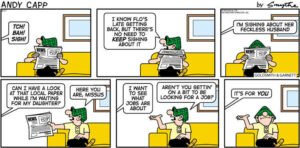
For over sixty years, a scruffy, unemployed man with a flat cap pulled over his eyes has been making readers around the world smile. Andy Capp, the brainchild of British cartoonist Reg Smythe, first appeared in the Daily Mirror on August 5, 1957, and quickly became a staple of newspaper comic strips . He isn’t a superhero, a brilliant detective, or a smooth-talking businessman. He is simply a working-class man from Hartlepool in Northern England who prefers the pub to the job center and his sofa to just about anything else . In a world where we are constantly bombarded with messages about success, ambition, and self-improvement, Andy Capp stands as a stubborn, hilarious monument to doing absolutely nothing.
His global success is a fascinating phenomenon. The strip is syndicated in hundreds of newspapers across North America and has been translated into numerous languages, proving that his appeal goes far beyond the British stereotypes he was built upon . But why does this “horrible little man,” as his own creator once called him, continue to resonate with so many people ? The answer lies not in his admirable qualities, because he has very few, but in his unapologetic embrace of human weakness. He gives us permission to laugh at the parts of ourselves we usually try to hide, from our laziness to our love of life’s simple, guilty pleasures.
10+ Andy Capp
Image Credit: Reg Smythe
#1
#2
#3
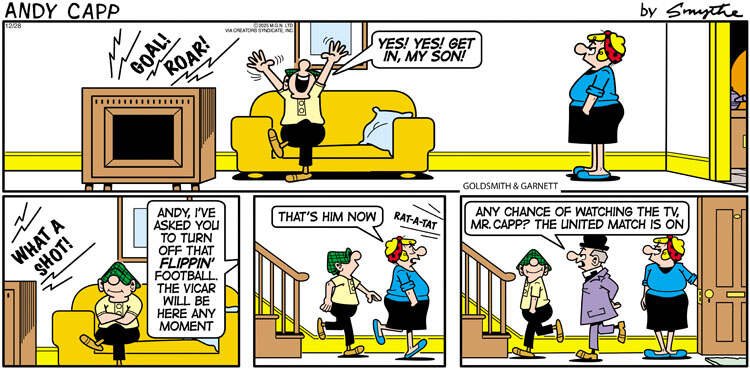
#4
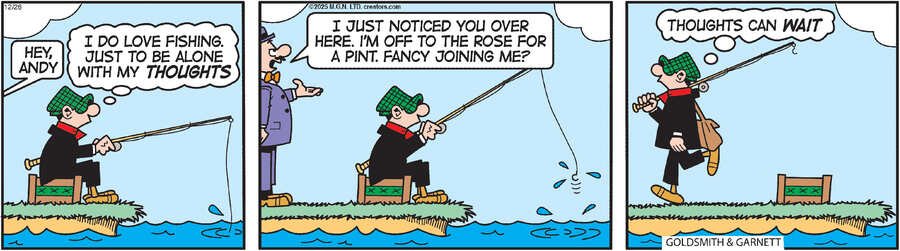
#5
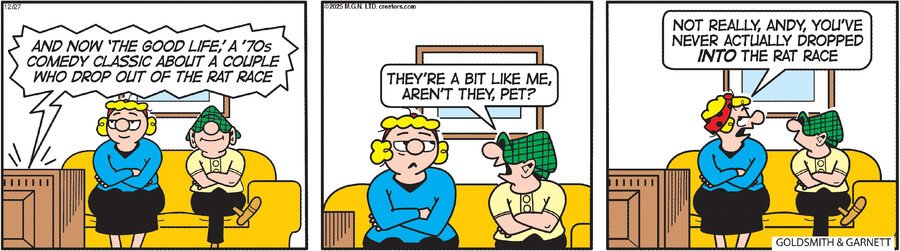
#6
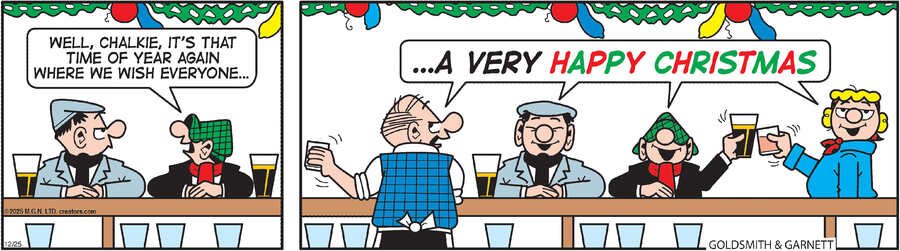
#7
#8
#9
#10
The Reluctant Everyman: A Hero for the Tired and Overworked
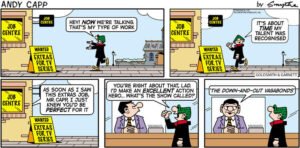
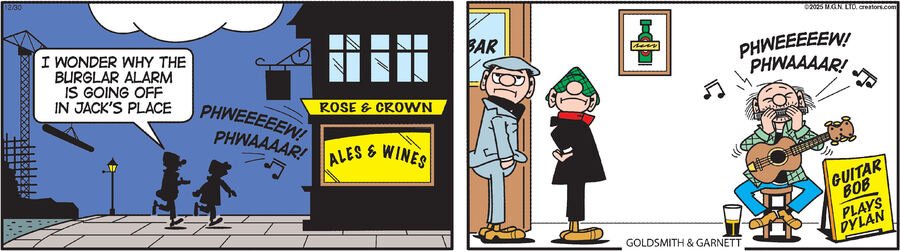
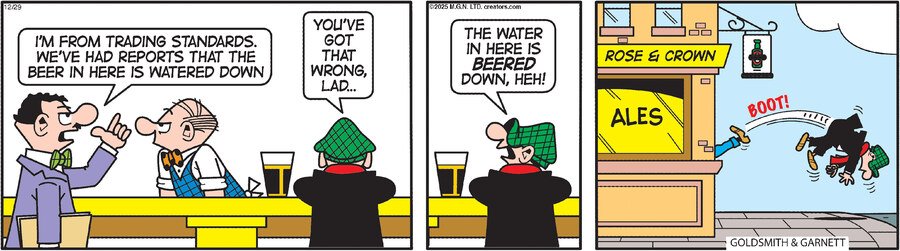
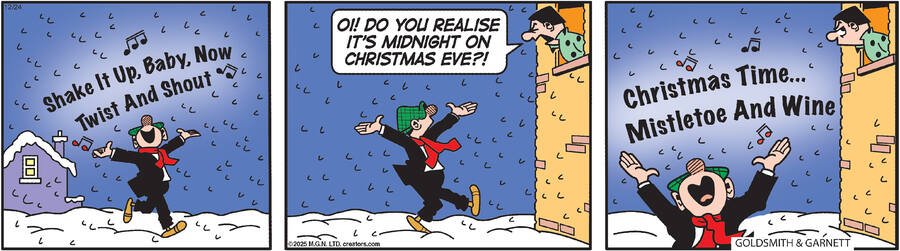
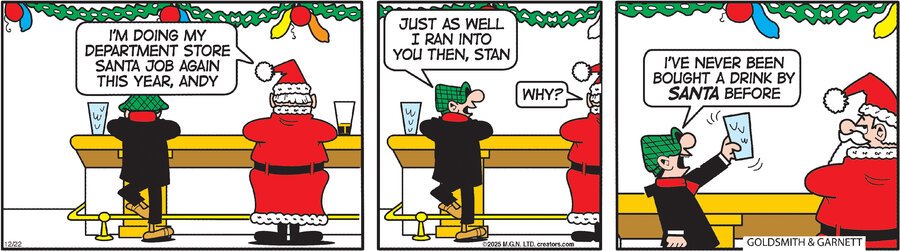
At his core, Andy Capp is the ultimate anti-ambitious everyman. While society praises the “hustle” and the constant pursuit of more, Andy is perfectly content with what he has—which isn’t much. His world revolves around a few key locations: his cozy (and often repossessed) house at 37 Durham Street, the local pub, and the football pitch . His hobbies include darts, snooker, pigeon racing, and betting on horses—usually losing badly . He is famously unemployed and lacks any motivation to change that status, often coming up with creative excuses to avoid the job centre .
This makes him incredibly relatable for the average reader. After a long week of work, bills, and responsibilities, there is a part of everyone that envies Andy’s simple life. He represents the dream of a weekend with no alarms, no deadlines, and nothing to do but watch a match and have a pint. His famous lounging pose on the couch is something many of us mimic on a Sunday afternoon. As one analysis of the character notes, his life is “an endless chase for booze and doing nothing,” which, while extreme, taps into a universal desire to sometimes just switch off from the world . He is the voice in the back of our heads that says, “Do I really have to?” and for that, we can’t help but love him.
Furthermore, his environment is instantly recognizable. The terraced house, the corner pub, the local characters—they form a backdrop of ordinary life that feels authentic. He isn’t navigating glamorous penthouses or exotic locales; he is navigating the struggles of keeping the lights on and avoiding the rent collector, Percy Ritson . This grounding in everyday working-class reality makes his world feel tangible. Readers don’t have to imagine a fantasy land; they just have to look out their window. He is a product of his environment, and for many, that environment mirrors their own or that of their neighbors, creating an instant bond of familiarity.
A Love Story for the Realists: The Unbreakable Bond with Flo
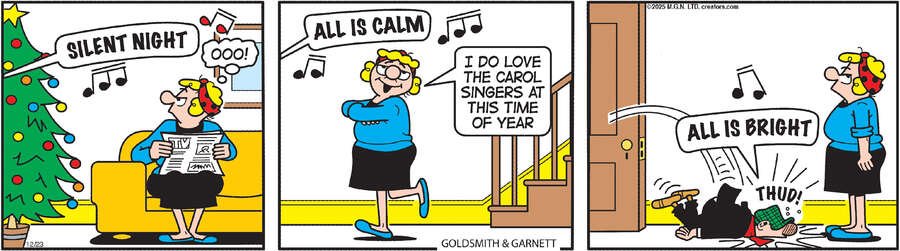
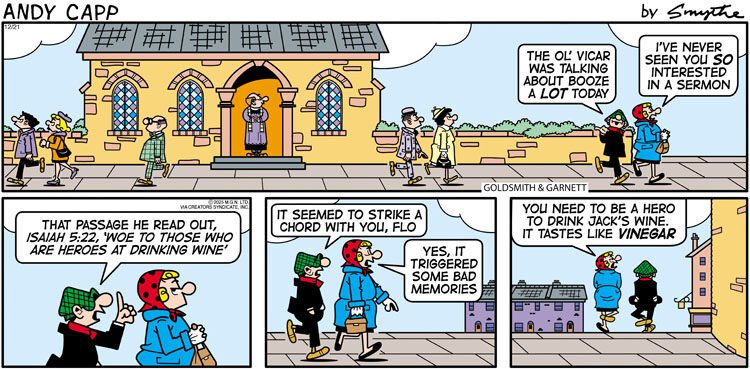
No discussion of Andy Capp is complete without talking about his long-suffering wife, Florrie, or “Flo.” Their relationship is the engine of the strip, and it is far more complex than it first appears. On the surface, it is a constant battle of wills. Flo works as a charwoman to bring in money, while Andy drinks it at the pub . She nags him about his laziness, his drinking, and his gambling, and he grumbles about her cooking (which is famously terrible) and her own hobby—going to bingo with their friend Rube .
However, beneath the bickering and the stylized clashes lies a deep, if unspoken, partnership. Andy always refers to Flo as “pet,” and despite his general belligerence, he is instantly ready to fight anyone who is rude to her . This duality is what makes their relationship so compelling. They are a team, even if they are a deeply dysfunctional one. They face the same struggles together: poverty, debt, and the monotony of daily life. Flo is not just a victim; she is a strong, resilient woman who gives as good as she gets, and Smythe himself said she was his favorite character, naming her after his own mother .
This portrayal of marriage is miles away from the perfect, sanitized couples often seen in media. It is messy, loud, and filled with conflict, but it is also enduring. They have been together for decades, and despite everything—the burnt meals, the missed rent, the trips to the marriage counselor—they are still there, in the same house, on the same street . For anyone who has been in a long-term relationship, this realism is refreshing. It acknowledges that love isn’t always about grand gestures; sometimes it’s about the person who is still there on the couch when you get home from work. They are two halves of the same whole, perfectly mismatched yet inseparably bound together.
A Mirror to Society: Evolving with the Times Without Losing Its Soul
One of the most remarkable aspects of Andy Capp is its ability to evolve. The strip from the 1950s is not the same strip we see today, and this willingness to change has been key to its survival. Early strips were much more explicit in their depiction of violence between Andy and Flo, something Reg Smythe later said he regretted, admitting the character was “too savage, a proper bully” . As societal attitudes changed, particularly regarding domestic violence, the strip changed with them. The physical fights were toned down and eventually phased out, replaced by verbal sparring and even sessions with a marriage counselor .
Another major shift came in 1983 when Andy famously quit smoking. For decades, a cigarette was as much a part of his look as his flat cap. When it disappeared, some fans cried foul, blaming political correctness. However, the real reason was far more personal and poignant: Reg Smythe himself had given up smoking and said, “there was no way Andy was going to carry on enjoying cigarettes when Reg couldn’t” . This anecdote perfectly captures the deep connection between the creator and his creation. Andy wasn’t just a product to be marketed; he was an extension of Smythe himself, and his evolution mirrored his creator’s life.
More recently, the strip has even touched on contemporary issues like Brexit, showing that it remains relevant . While some long-time readers might lament the loss of the “edgier” Andy, this ability to adapt has prevented the character from becoming a fossil. He no longer reflects the casual misogyny or smoking culture of the 1950s, but he still perfectly reflects the spirit of a certain kind of bloke. He proves that a character can lose a cigarette or a fistfight but still retain his soul. The core of Andy—the lazy, beer-loving, sofa-dwelling anti-hero—remains intact, simply navigating a slightly more politically correct world.
Conclusion: The Eternal Appeal of the Lovable Loser
In a cultural landscape filled with perfect heroes and aspirational figures, Andy Capp endures because he is the opposite of all that. He is the lovable loser, the man who has given up on the rat race and found his own small corner of happiness. He allows us to laugh at the absurdities of life, from the daily grind to the complications of marriage, without ever pretending to have the answers. His humor is dry, his world is small, and his ambitions are limited to his next pint, and yet that simplicity is his greatest strength .
He is a testament to the genius of Reg Smythe, who took the people and places he knew from his own life in Northern England and turned them into universal archetypes . Andy Capp is the bloke down at the pub, the grumpy neighbor, the lazy uncle we all have in the family. He is us on our worst days, and we love him for it. As long as there are sofas to lie on, beers to drink, and bills to (sort of) pay, Andy Capp will remain one of the most relatable characters in the history of comics. He may be a “handicap” to his wife and society, but to his millions of fans, he is an absolute treasure .