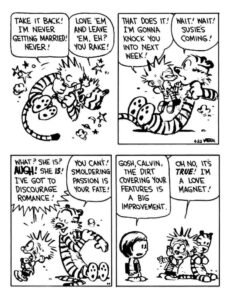
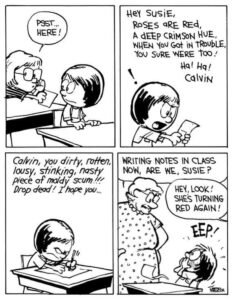
It’s hard to believe that it has been three decades since we said goodbye to a six-year-old troublemaker and his philosophical tiger. On December 31, 1995, Bill Watterson published the final strip of “Calvin and Hobbes,” sending the duo sledding into a snowy landscape with the simple, perfect line: “It’s a magical world, Hobbes, ol’ buddy… let’s go exploring” . For millions of readers, it felt like losing old friends. Yet, even after all these years, picking up a collection of Calvin and Hobbes feels less like reading an old comic and more like coming home.
The strip ran for just ten years, from 1985 to 1995, but its magic hasn’t faded . In fact, it seems to grow stronger with each passing generation. College students who weren’t even born when the strip ended still pack into classes to study it, and parents who grew up with Calvin are now passing those tattered books down to their own children . Why does this particular boy and his tiger continue to resonate so deeply in our hearts and homes? The answer lies in the beautiful, simple truths Watterson embedded in every panel.
Calvin and Hobbes 10 + comics
#1

#2

#3

#4

#5

#6

#7

#8

#9

#10

Image Credit : Bill Watterson
The Magic of Endless Imagination and Childhood Play
At its core, “Calvin and Hobbes” is a celebration of imagination. For Calvin, a cardboard box is never just a box; it’s a “transmogrifier,” a time machine, or a portal to another dimension . A trip to the backyard becomes a safari through alien jungles, and a snowman is never just a snowman—it’s a piece of avant-garde art meant to comment on the absurdity of existence . This boundless creativity is the first thing that makes the strip feel like home. It reminds us of a time when the world was full of possibility, long before bills, deadlines, and adult responsibilities boxed us in.
This imaginative world is anchored by the brilliant ambiguity of Hobbes himself. To Calvin, Hobbes is a life-sized, witty companion who pounces on him the second he gets home from school. To everyone else, he’s just a stuffed tiger sitting quietly on the bottom of the bed . Watterson never clarifies which version is “real,” and that’s the point. He once explained that he shows “two versions of reality, and each makes complete sense to the participant who sees it” . This invites us, the readers, to participate in the magic. We get to be in on the secret, seeing the world through the eyes of childhood.
By celebrating this creative play, the strip acts as a gentle nudge to the adults reading it. It asks us to remember that a walk in the woods is better when you imagine what might be lurking behind the trees, or that a snowy day isn’t an inconvenience—it’s an opportunity for a sled ride. In a world that constantly pushes us to grow up and be serious, Calvin’s imagination gives us permission to slow down and remember the joy of simply being .
Navigating Life’s Big Questions with Heart and Humor
One of the reasons “Calvin and Hobbes” feels so profound is that it never talks down to its audience. Beneath the slapstick humor of snowballs and school reports, Watterson tackled some of the biggest philosophical questions imaginable. Calvin grapples with existential dread, wondering if his life matters in the vastness of the universe. In one famous strip, he screams “I’m significant!” only to realize he’s just a tiny speck of dust in the cosmos . These moments could be heavy, but they are always filtered through the lens of a six-year-old trying to make sense of the world.
This exploration of the “human condition” is what gives the strip its lasting depth. Whether they are debating the existence of God, the nature of good and evil, or the meaning of life, Calvin and Hobbes handle these topics with a unique blend of cynicism and warmth . Calvin might declare that humanity is selfish and greedy, and Hobbes will calmly agree, reminding us that “the only problem with people is that they’re only human” . These conversations never feel preachy. Instead, they feel like the kind of quiet, important talks you might have with your best friend late at night.
Ultimately, Watterson suggests that while life may be confusing and often absurd, it is also beautiful. When Calvin frets about the future or the point of it all, Hobbes usually brings him back to the present. Hobbes finds happiness in simple things—”a big sunny field” or a warm fire . The strip teaches us that you don’t need to have all the answers to enjoy the ride. It’s okay to question everything, as long as you remember to hold on to the people (or tigers) who make the journey worthwhile.
A Gentle Critique of Modern Life and Shopping.
While Calvin lives in a world of dinosaurs and spaceships, Bill Watterson kept a keen eye on the real world, and he wasn’t always happy with what he saw. The strip is filled with sharp, hilarious critiques of consumerism, the media, and the education system. Calvin once begged his parents for a logo T-shirt, not because he liked the product, but because he thought it would be cool to show he “paid the company to advertise its products” . He sees through the nonsense of advertising with a clarity that most adults lose.
Watterson’s own battle against commercialization is legendary and adds a layer of integrity to the strip that still feels refreshing today. At the height of the strip’s popularity, he was offered millions of dollars to license his characters for T-shirts, plush toys, and animated specials. Unlike almost every other successful cartoonist, he famously refused . He believed that if he sold a Hobbes doll, it would destroy the magic of the strip—it would answer the question of Hobbes’s reality, and the mystery would be gone . This decision meant leaving a fortune on the table, but it preserved the soul of his work.
This resistance to the “machine” makes the strip feel pure and timeless. It isn’t tied to a forgotten toy line or a bad Saturday morning cartoon. It exists exactly as Watterson intended: as art . By watching Calvin rage against homework, mock shallow consumer culture, and mourn the loss of forests to condos, we see a reflection of our own frustrations with the world . It reminds us that it’s okay to question the status quo and that the pursuit of happiness is far more important than the pursuit of more stuff.
The Lasting Bond of True Friendship
If you ask most fans what makes “Calvin and Hobbes” feel like home, they will likely point to the friendship at the center of it all. Calvin and Hobbes are an odd couple—one is impulsive, selfish, and loud; the other is calm, thoughtful, and sarcastic. Yet, they are inseparable. Their relationship is the emotional anchor of the strip. No matter how bad Calvin’s day gets—whether he’s been bullied by Moe or scolded by his mom—you know that when he walks through the door, Hobbes will be there to pounce .
This friendship represents a safe space. With Hobbes, Calvin can be his true self—whether that’s the brave Spaceman Spiff, the terrible baseball player, or the scared little boy worried about the dark. They fight, they make up, and they explore the world together. This dynamic resonates with readers because it taps into a universal desire for unconditional acceptance. We all want a Hobbes—someone who sees us at our worst and still thinks we’re pretty great.
The depth of this bond is what makes the ending of the strip so powerful. In that final sled ride, they don’t know what lies ahead, and they don’t care. They have each other. The final line, “Let’s go exploring,” isn’t just about the physical landscape; it’s about facing the future with your best friend by your side . It’s a comforting message for readers of all ages. Life is a big, scary, wonderful adventure, and it’s infinitely better when you have someone to share it with. That feeling of loyal companionship is the ultimate reason why, thirty years later, revisiting Calvin and Hobbes still feels like going home.